Earth Science · Water & Engineering
Water Filtration Challenge: Design, Test & Improve a Filter
Free fifth grade water filtration STEM lesson. Design and compare safe model filters, measure water clarity and collection, redesign using evidence, and explain why clearer water is not necessarily safe to drink.
Read the science notes ↓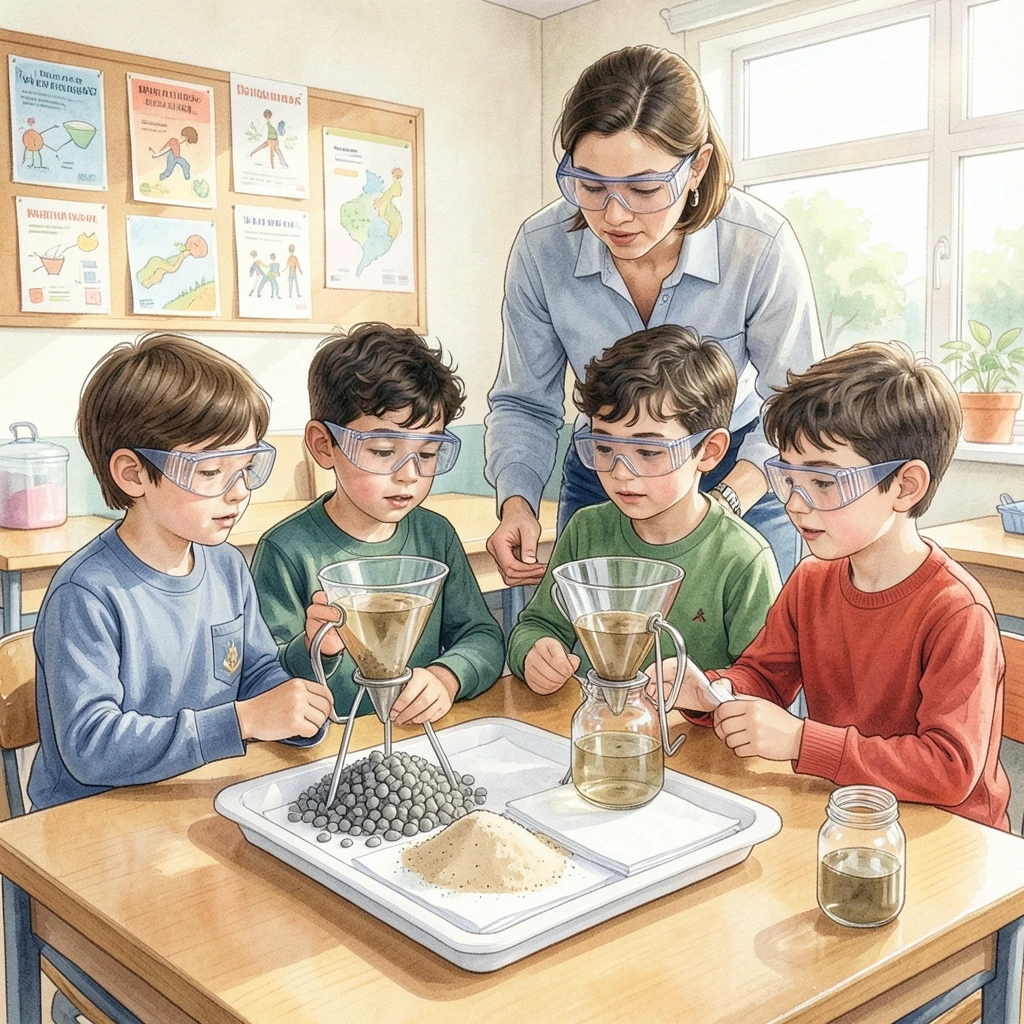
A quick look inside this lesson
What happens in class?
Question to start with
Will visibly cleaner mean safe to drink?
What students actually do
List what might be removed and what cannot be seen.
Evidence of learning
Data-based evaluation and safety limitation.
One question from the printable worksheet
A team has three materials: clean gravel, cloth, and a coffee filter. Write one sensible prototype plan and say why you chose the layer arrangement.
Lesson plan
Water Filtration Challenge: Design, Test & Improve a Filter
A step-by-step guide to help you teach this lesson.
Extra context for teachers
Science notes: Water Filtration Challenge: Design, Test & Improve a Filter
A short concept refresher and teaching perspective. The full procedure, printable materials, and student tasks are available in the lesson resources above.
Science in context
A classroom water filter is a design problem with competing goals rather than a competition to make a sample look pretty. One filter may remove more visible sediment but collect very little water, while another passes more water and leaves it cloudier. Students should agree on what to measure before deciding which design meets their criteria.
Clarity is never a drinking-water safety test. Transparent water can still contain microorganisms or dissolved substances. Model filters built from classroom materials must not be presented as methods for making water safe to drink. That limitation is itself an important engineering conclusion: a device only solves the problems that its tests can actually demonstrate.
Science reference: CDC — About Choosing Home Water Filters
What makes the idea observable?
Two teams build different filters using the same classroom materials. Both remove some visible dirt, but one collects more water. Which one is 'best,' and what evidence would help decide?
This is a model of filtration, NOT drinking-water purification. No water used or produced in the lesson may be consumed.
A misconception worth addressing
- Clear water is NOT evidence of drinking-water safety.
- Simple filters do not reliably remove dissolved salt or microorganisms.
A practical teaching move
Compare two prototype data records against the same criteria, such as visible clarity and recovered volume. Have students justify one redesign without claiming the collected water is safe.
Verified curriculum references
Plan with confidence
Lesson overview
What students will learn
- Describe what classroom filters can and cannot remove from modeled dirty water.
- Use criteria, constraints, and a fair test to compare two filter designs using visible particles and recovered water volume.
Key science ideas
- Filtration can catch larger suspended particles as water moves through a material.
- The filter material, particle size and path can affect clarity, speed and amount of water collected.
- Clear-looking water may still contain dissolved substances and microorganisms that a simple classroom filter cannot remove.
Lesson at a glance
- Grade 5
- 55 min
- ~20 min prep
- 3-5-ETS1-2
- 11 materials
What’s included
- Lesson Plan
- Investigation
- Teacher Slides
- Printable Worksheet
- Teacher Answer Key
- Interactive Activity
- Vocabulary