Physical Science · Heat & Materials
Insulators & Conductors: Which Materials Transfer Heat?
Compare how quickly thermal energy moves through different materials, then use evidence to choose a material for a simple design problem.
Read the science notes ↓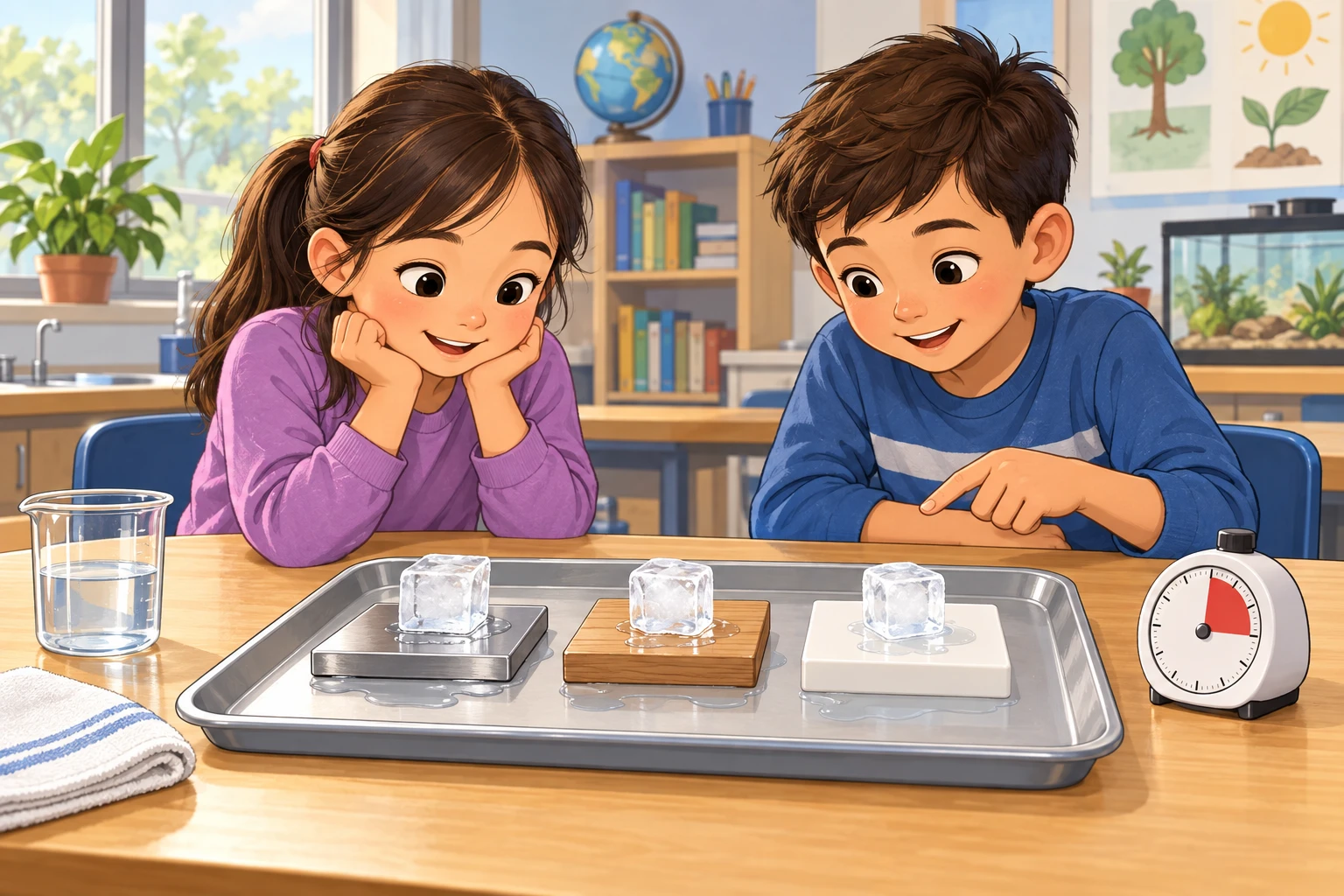
A quick look inside this lesson
What happens in class?
Question to start with
How could we test instead of guess?
What students actually do
Observe for a set time and record relative melting.
Evidence of learning
Same-time melt evidence.
Lesson plan
Insulators & Conductors: Which Materials Transfer Heat?
A step-by-step guide to help you teach this lesson.
Extra context for teachers
Science notes: Insulators & Conductors: Which Materials Transfer Heat?
A short concept refresher and teaching perspective. The full procedure, printable materials, and student tasks are available in the lesson resources above.
Science in context
Choose a material for the job
A conductor can be useful when we want thermal energy to move quickly.
What makes the idea observable?
Equal ice cubes sit on metal, wood, and plastic samples that started in the same room. Which cube changes fastest? What result would be evidence of faster heat transfer?
Keep the focus on observable melting. Do not teach particle motion or ask students to judge temperature only by touch.
A misconception worth addressing
- A material feeling cold does not mean it contains more cold.
- Do not claim every metal or every plastic behaves exactly the same.
Teacher tip
- Read all prompts aloud.
- Use picture cards for conductor/insulator.
Verified curriculum references
Plan with confidence
Lesson overview
What students will learn
- Observe that different materials can transfer thermal energy at different rates.
- Use evidence from a fair ice-melt test to compare a conductor with an insulator.
Key science ideas
- Thermal energy moves from warmer objects or places toward cooler ones.
- Some materials let thermal energy move through them faster than others.
- Metals often conduct thermal energy well; materials such as wood, foam, and many plastics usually transfer it more slowly.
Lesson at a glance
- Grade 2
- 40 min
- ~10 min prep
- 6 materials
What’s included
- Lesson Plan
- Investigation
- Teacher Slides
- Printable Worksheet
- Teacher Answer Key
- Interactive Activity
- Vocabulary