Physical Science · Matter & Materials
Air Is Matter: It Takes Up Space & Can Push
Use balloons, cups, bags, and syringes to gather evidence that invisible air takes up space and can push on objects.
Read the science notes ↓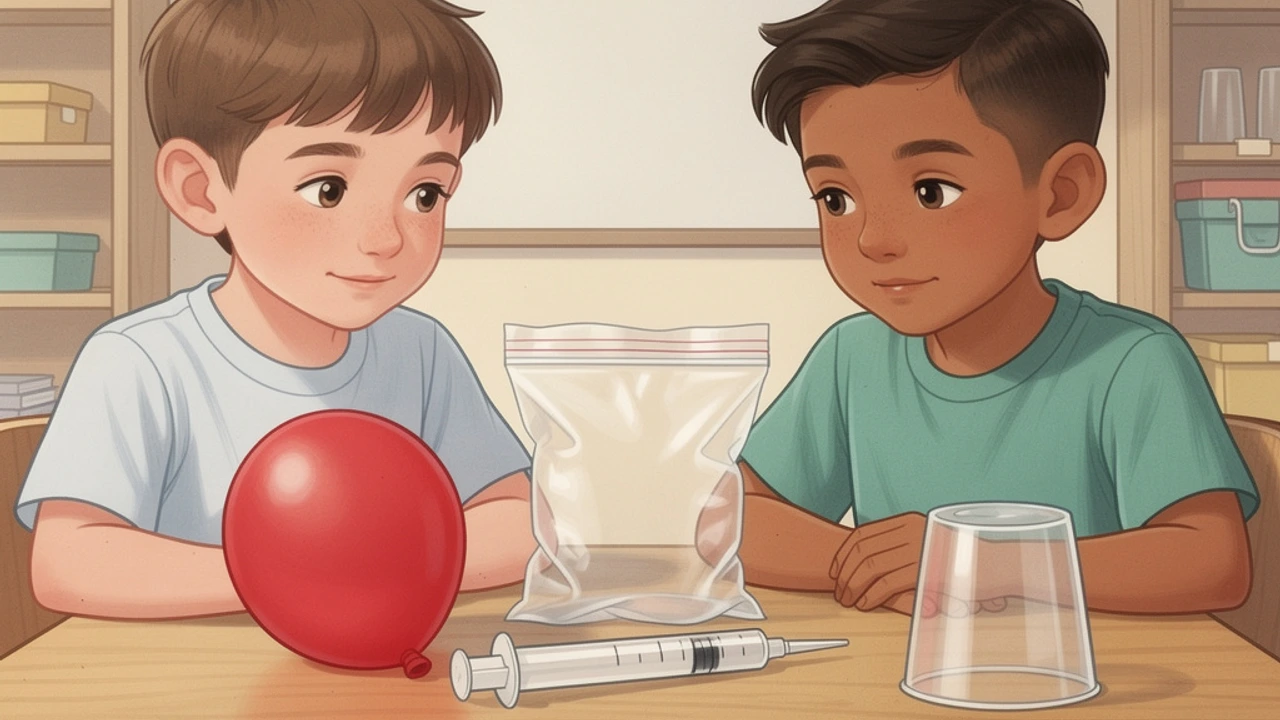
A quick look inside this lesson
What happens in class?
Question to start with
What made the balloon larger?
What students actually do
Observe each result and record what changed.
Evidence of learning
Clear claim plus visible evidence.
One question from the printable worksheet
Finish the claim: I know air is matter because ___.
Lesson plan
Air Is Matter: It Takes Up Space & Can Push
A step-by-step guide to help you teach this lesson.
Extra context for teachers
Science notes: Air Is Matter: It Takes Up Space & Can Push
A short concept refresher and teaching perspective. The full procedure, printable materials, and student tasks are available in the lesson resources above.
Science in context
Children frequently use the word 'empty' for a cup that seems to contain nothing. In science, that cup normally contains air. The presence of air becomes easier to reason about when the class looks for a change: a balloon expanding, a paper towel staying dry in an inverted cup or a closed syringe resisting compression.
These examples are not interchangeable. Expanding a balloon shows that additional air occupies space. Pressing on a sealed syringe reveals that trapped air can be compressed while pushing back. Both observations support the idea that invisible matter has measurable effects; neither means that air appears from nowhere or disappears when squeezed.
Science reference: Smithsonian — Can air take up space?
What makes the idea observable?
What moves, expands, stays dry, or pushes back when air is trapped or moved?
Describe the visible result first, then connect it to the idea that air takes up space.
A misconception worth addressing
- Invisible does not mean nonexistent.
- The cup is not truly empty before it enters the water.
A practical teaching move
Invite students to predict what will happen before each demonstration, then separate their actual observation from their explanation about the unseen air.
Verified curriculum references
Plan with confidence
Lesson overview
What students will learn
- Use observations to show that air takes up space even when we cannot see it.
- Use evidence to explain how trapped air can push back when it is squeezed.
Key science ideas
- Air usually cannot be seen, but we can observe what it does.
- Air takes up space. A balloon gets larger when more air moves inside.
- Trapped air can push back when it is pressed into a smaller space.
Lesson at a glance
- Grade 2
- 40 min
- ~10 min prep
- 8 materials
What’s included
- Lesson Plan
- Investigation
- Teacher Slides
- Printable Worksheet
- Teacher Answer Key
- Interactive Activity
- Vocabulary