Earth Science · Earth Materials
Soil Properties: Which Material Holds Water Best?
Compare prepared sand, silt-rich soil, and clay-rich soil with equal water tests to describe how different earth materials let water pass through or remain in the sample.
Read the science notes ↓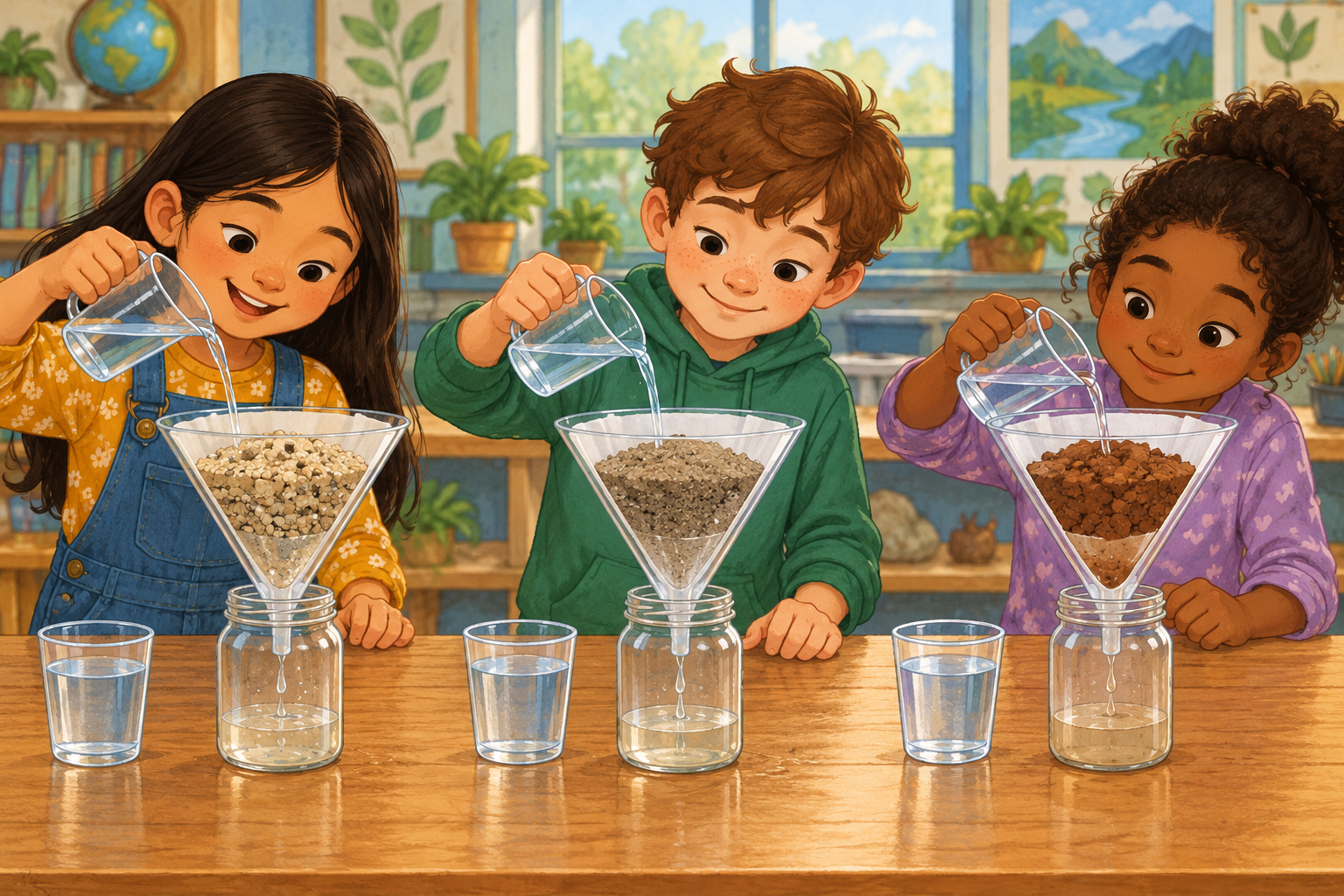
A quick look inside this lesson
What happens in class?
Question to start with
Which sample looks coarse? Which looks fine?
What students actually do
Pour equal water, wait the same time, and measure collected water.
Evidence of learning
Numerical evidence tied to the claim.
Lesson plan
Soil Properties: Which Material Holds Water Best?
A step-by-step guide to help you teach this lesson.
Extra context for teachers
Science notes: Soil Properties: Which Material Holds Water Best?
A short concept refresher and teaching perspective. The full procedure, printable materials, and student tasks are available in the lesson resources above.
Science in context
Measure instead of guessing
Color alone cannot tell you how much water a sample will hold. A fair test uses equal sample amounts, equal water, equal containers, and the same waiting time.
What makes the idea observable?
Equal cups of water are poured through equal amounts of three prepared earth materials. One tray fills quickly; another collects much less water. What can you measure?
Compare the same time interval and the same starting water amount before deciding which sample held more water.
A misconception worth addressing
- Dark color alone tells how much water soil holds.
- All clay-rich samples behave exactly the same.
Teacher tip
- Use clear measuring cups with large marks.
- Provide a data table with sample icons.
Verified curriculum references
Plan with confidence
Lesson overview
What students will learn
- I can describe visible differences among prepared soil materials.
- I can run an equal-water comparison and measure the water that drains through.
Key science ideas
- Sand feels gritty because its particles are relatively large.
- Silt is finer than sand, while clay has very tiny particles.
- Water can move through the spaces between particles.
Lesson at a glance
- Grade 2
- 45 min
- ~15 min prep
- 2-PS1-1
- 7 materials
What’s included
- Lesson Plan
- Investigation
- Teacher Slides
- Printable Worksheet
- Teacher Answer Key
- Interactive Activity
- Vocabulary