Life Science · Animal Activity Patterns
Nocturnal & Diurnal Animals: Who Is Active When?
Use repeated picture observations to compare animals active mostly in daylight with animals active mostly at night, then use time-of-day evidence to identify an activity pattern.
Read the science notes ↓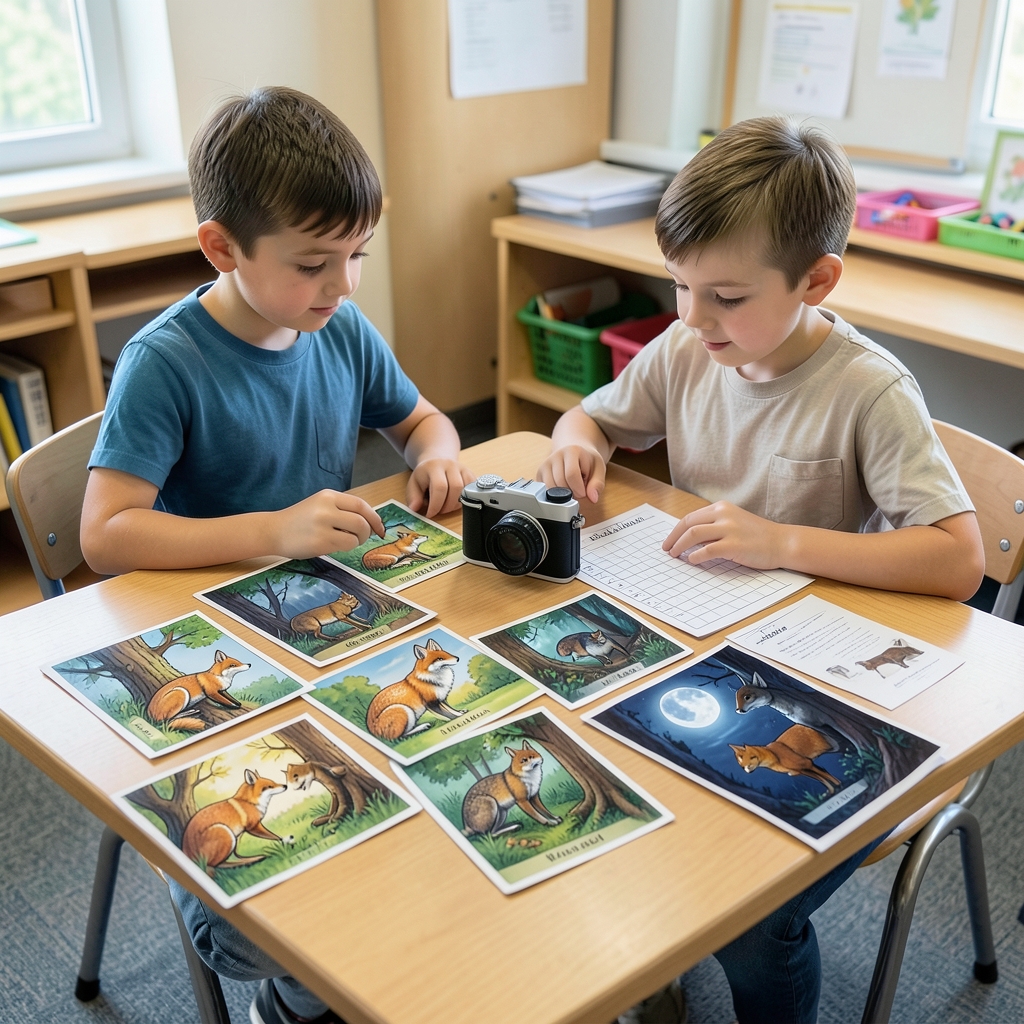
A quick look inside this lesson
What happens in class?
Question to start with
What tells you it is day?
What students actually do
Sort observations by day or night and count where each animal appears most often.
Evidence of learning
Pattern + evidence.
Lesson plan
Nocturnal & Diurnal Animals: Who Is Active When?
A step-by-step guide to help you teach this lesson.
Extra context for teachers
Science notes: Nocturnal & Diurnal Animals: Who Is Active When?
A short concept refresher and teaching perspective. The full procedure, printable materials, and student tasks are available in the lesson resources above.
Science in context
A pattern is not a rule with no exceptions
An owl seen hunting on several nights gives evidence of nighttime activity. A squirrel seen feeding on several bright mornings gives evidence of daytime activity.
What makes the idea observable?
Is the scene bright or dark? Do you see the Sun, moon, stars, or artificial lights? What is the animal doing?
Use both the time-of-day clue and the animal's behavior. One picture is an example; repeated pictures give stronger evidence of a pattern.
A misconception worth addressing
- Nocturnal does not mean an animal is awake every second of the night.
- Diurnal does not mean an animal can never be seen at night.
Teacher tip
- Use day/night picture mats before introducing vocabulary.
- Allow pointing and counting before oral explanation.
Verified curriculum references
Plan with confidence
Lesson overview
What students will learn
- Use picture or observation evidence to identify whether an animal is active mostly in daylight or mostly at night.
- Use the words nocturnal and diurnal to describe repeated activity patterns.
Key science ideas
- Some animals are active mostly during daylight. We can call this a diurnal pattern.
- Some animals are active mostly at night. We can call this a nocturnal pattern.
- Scientists use repeated observations to look for a pattern.
Lesson at a glance
- Grade 1
- 37 min
- ~8 min prep
- 4 materials
What’s included
- Lesson Plan
- Investigation
- Teacher Slides
- Printable Worksheet
- Teacher Answer Key
- Interactive Activity
- Vocabulary