Life Science · Heredity & Variation
DNA, Genes & Chromosomes: How Traits Are Inherited
Model how genes are organized on chromosomes, compare sexual and asexual inheritance, and explain conceptually how mutations can alter proteins and affect traits.
Read the science notes ↓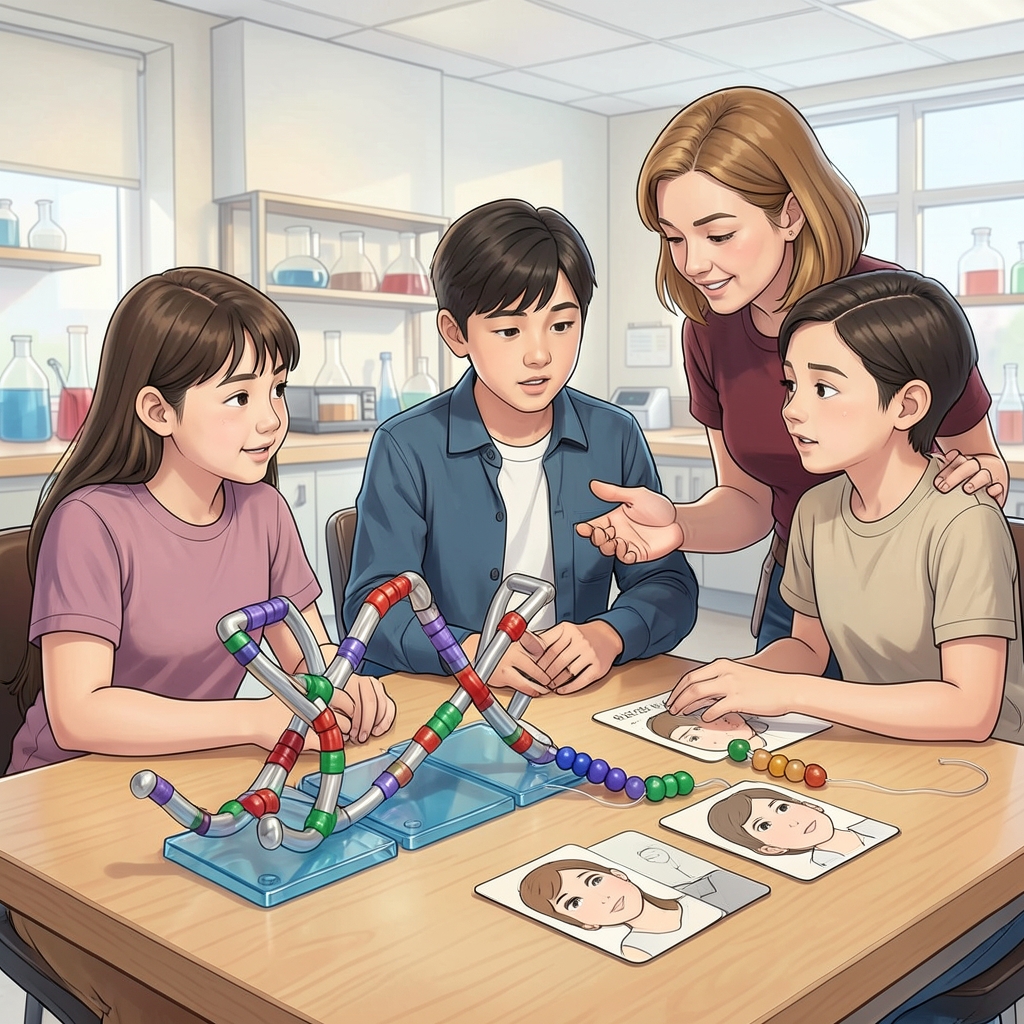
A quick look inside this lesson
What happens in class?
Question to start with
What must a model show to explain both similarity and variation?
What students actually do
Build several offspring combinations and compare with an asexual copy model.
Evidence of learning
Accurate chromosome transmission and conceptual gene-protein-trait reasoning.
Teacher workspace
Start with the lesson plan.
Lesson Plan
Extra context for teachers
Science notes: DNA, Genes & Chromosomes: How Traits Are Inherited
A short concept refresher and teaching perspective. The full procedure, printable materials, and student tasks are available in the lesson resources above.
Science in context
Variation comes from genetic combinations
In the simplified diploid model used here, offspring receive one member of each chromosome pair from each parent rather than both copies from each parent, producing different combinations of inherited genetic information.
Mutation effects are modeled conceptually
A mutation changes genetic information. If that change alters the information used to make a protein, the protein may change in a way that affects structure or function.
What makes the idea observable?
A chromosome model contains a highlighted gene region. Where is the DNA? Where is the gene? Which level carries many genes?
The chromosome contains DNA; the gene is a segment of that DNA; the chromosome carries many genes.
A misconception worth addressing
- Genes and chromosomes are related but are not the same thing.
- Sexual reproduction does not give an offspring every chromosome copy from both parents.
Teacher tip
- Use color plus letter labels for chromosome pairs so color is not the only cue.
- Provide a partially completed inheritance diagram.
Plan with confidence
Lesson overview
What students will learn
- Explain the relationship among DNA, genes, and chromosomes using a model.
- Model why sexual reproduction produces genetic variation while asexual reproduction usually copies the parent's genetic information.
Key science ideas
- DNA stores genetic information.
- Genes are segments of DNA located on chromosomes.
- Chromosomes carry many genes.
Lesson at a glance
- Grade 6
- 55 min
- ~12 min prep
- MS-LS3-1 · MS-LS3-2
- 5 materials
What’s included
- Lesson Plan
- Investigation
- Teacher Slides
- Printable Worksheet
- Teacher Answer Key
- Interactive Activity
- Vocabulary