Earth Science · Dynamic Earth
Plate Tectonics: A Changing Earth
Use maps and models to connect plate motion with earthquakes, volcanoes, mountain building, and pathways through the rock cycle.
Read the science notes ↓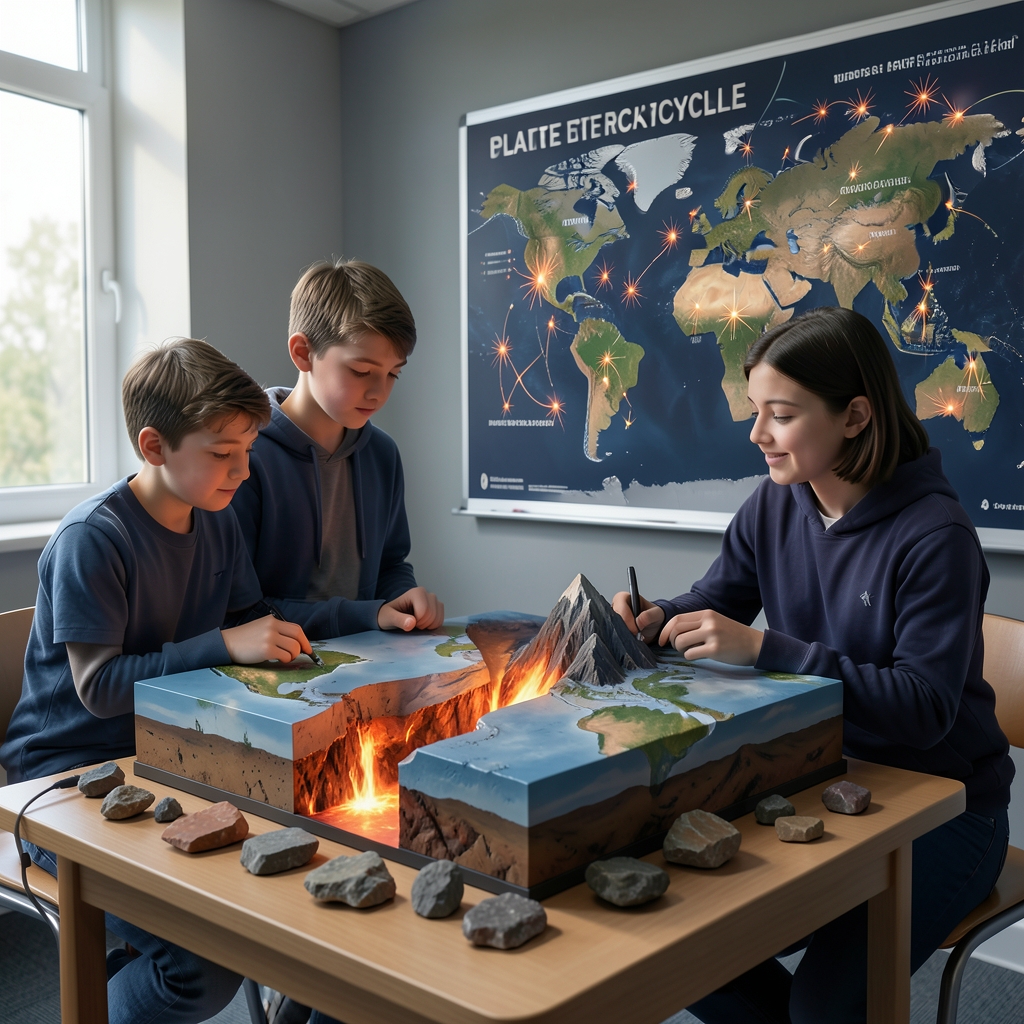
A quick look inside this lesson
What happens in class?
Question to start with
Where do events cluster?
What students actually do
Compare plate motion and build several valid material pathways.
Evidence of learning
Accurate, appropriately limited claims.
Lesson plan
Plate Tectonics: A Changing Earth
A step-by-step guide to help you teach this lesson.
Extra context for teachers
Science notes: Plate Tectonics: A Changing Earth
A short concept refresher and teaching perspective. The full procedure, printable materials, and student tasks are available in the lesson resources above.
Science in context
Boundary type matters
Different plate interactions produce different geologic settings. A divergent boundary is not simply the opposite picture of every convergent boundary.
Connect tectonics with Earth materials
Internal energy helps drive tectonic processes. Surface processes such as weathering, transport, and deposition are strongly influenced by solar energy and gravity.
What makes the idea observable?
A map shows many earthquake locations forming narrow belts that broadly match plate boundaries. What claim is supported?
Describe the spatial pattern first, then connect it to plate interactions. Do not claim that every earthquake lies exactly on a boundary.
A misconception worth addressing
- The rock cycle is not one mandatory sequence.
- The mantle is mostly solid rock that deforms and flows slowly; plates do not float on a global liquid magma ocean.
Teacher tip
- Provide boundary-motion arrow cards.
- Use sentence frames for claim–evidence–reasoning.
Verified curriculum references
Plan with confidence
Lesson overview
What students will learn
- I can use a map pattern to support a tectonic explanation.
- I can compare divergent and convergent plate-boundary models.
Key science ideas
- Earth's outer shell is divided into moving tectonic plates.
- Earthquakes and volcanoes often cluster in broad zones near plate boundaries.
- At divergent boundaries, plates move apart and new crust can form.
Lesson at a glance
- Grade 6
- 55 min
- ~10 min prep
- MS-ESS2-1
- 5 materials
What’s included
- Lesson Plan
- Investigation
- Teacher Slides
- Printable Worksheet
- Teacher Answer Key
- Interactive Activity
- Vocabulary