Physical Science · Science Practices
Scientific Method: Ask, Test, Measure & Explain
Turn a question into a fair test, change one variable, collect repeated data, and use evidence to explain what the results support.
Read the science notes ↓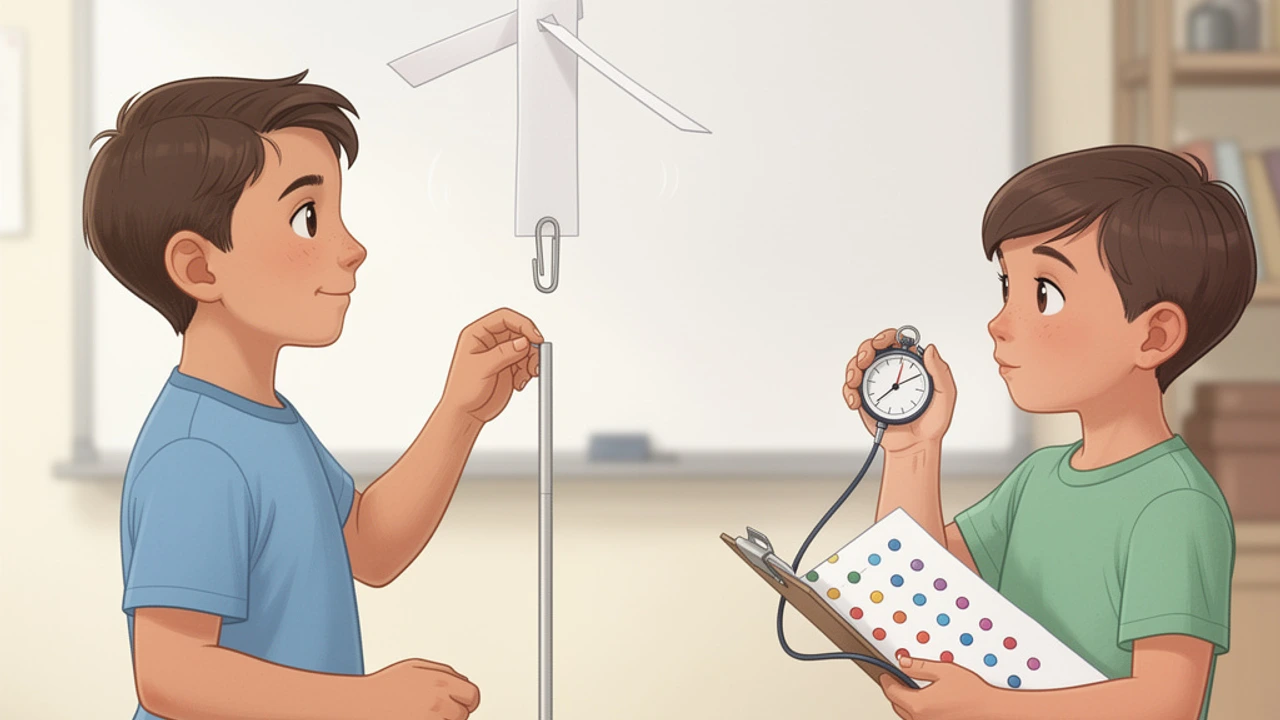
A quick look inside this lesson
What happens in class?
Question to start with
Which question could we answer with measurements?
What students actually do
Identify the tested variable, controls, and fall-time measurement, then collect repeated trials.
Evidence of learning
A bounded conclusion tied to evidence.
One question from the printable worksheet
Why should the group repeat the unusual trial instead of deleting it immediately?
Lesson plan
Scientific Method: Ask, Test, Measure & Explain
A step-by-step guide to help you teach this lesson.
Extra context for teachers
Science notes: Scientific Method: Ask, Test, Measure & Explain
A short concept refresher and teaching perspective. The full procedure, printable materials, and student tasks are available in the lesson resources above.
Science in context
An investigation is stronger when its question, measurement and comparison fit together. In a paper-spinner test, asking whether wing length changes fall time suggests measuring time rather than deciding which spinner looks best. Changing wing length while also changing the drop height would make the result harder to interpret: a difference in time could have more than one cause.
Real measurements vary. Three drops rarely give perfectly identical times because release and timing are imperfect. Repeated trials help students notice that variation; they do not guarantee that an experiment is accurate. The scientific process also is not one fixed sequence of steps: an unexpected result can lead a group to revise the question or improve the test, and that is part of careful science rather than a failure.
Science reference: NASA — How the scientific method works
What makes the idea observable?
What changed? What stayed the same? What was measured? How many trials were repeated?
Use those questions to decide whether a comparison gives strong evidence.
A misconception worth addressing
- The scientific method is not one rigid sequence that scientists never revisit.
- Controls are conditions kept the same, not a separate group required in every investigation.
A practical teaching move
Show two short spinner data tables, one with a consistent drop height and one with changing heights. Ask students which comparison better answers the question and what they would improve before drawing a claim.
Verified curriculum references
Plan with confidence
Lesson overview
What students will learn
- Recognize a testable science question and identify the variable being changed.
- Plan a fair investigation by keeping important conditions the same and repeating trials.
Key science ideas
- A testable question can be answered with observations or measurements.
- In a fair comparison, scientists change one important variable and keep other important conditions the same.
- Repeating trials helps show whether a result is consistent or unusual.
Lesson at a glance
- Grade 3
- 45 min
- ~12 min prep
- 5 materials
What’s included
- Lesson Plan
- Investigation
- Teacher Slides
- Printable Worksheet
- Teacher Answer Key
- Interactive Activity
- Vocabulary