Physical Science · Forces & Motion
Friction Experiment: Which Surface Slows Motion?
Run a fair sliding test on different surfaces, measure how far an object travels, and use the results to explain how friction can change motion.
Read the science notes ↓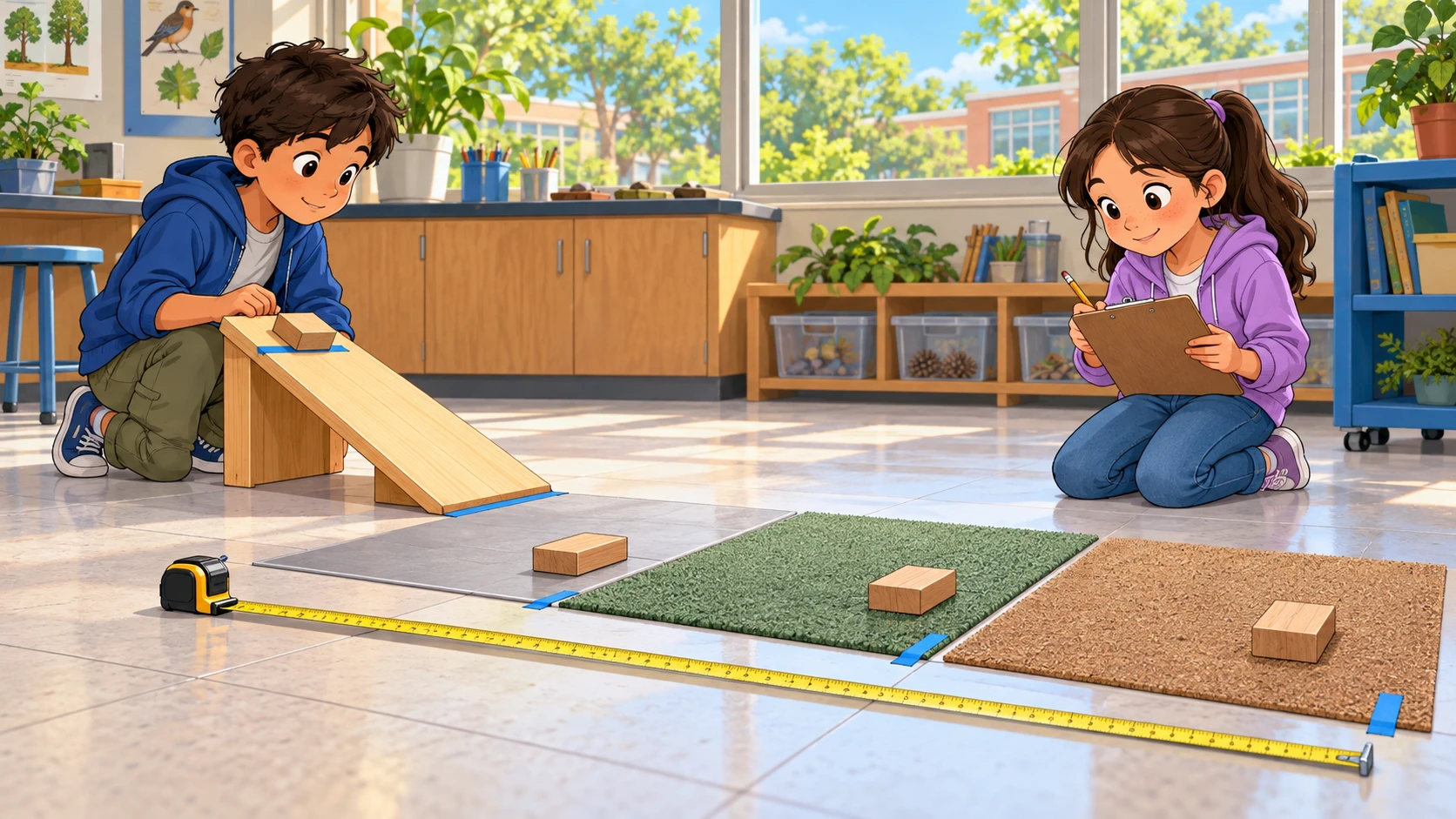
A quick look inside this lesson
What happens in class?
Question to start with
What could we measure instead of saying one surface 'looks rougher'?
What students actually do
Release from the same point, measure stopping distance, record results, and repeat.
Evidence of learning
Evidence-based, bounded claims.
Lesson plan
Friction Experiment: Which Surface Slows Motion?
A step-by-step guide to help you teach this lesson.
Extra context for teachers
Science notes: Friction Experiment: Which Surface Slows Motion?
A short concept refresher and teaching perspective. The full procedure, printable materials, and student tasks are available in the lesson resources above.
Science in context
Distance can be evidence
If the same block slides a shorter distance on one surface in the same test, that result is evidence that the surface produced more friction in this setup.
What makes the idea observable?
A block slides from the same ramp onto tile, felt, and sandpaper. Which measurement would help you compare the surfaces fairly?
Focus on stopping distance from the end of the ramp. Keep the block, ramp height, release point, and release method the same, and do not add an extra push.
A misconception worth addressing
- Rough-looking does not always mean more friction in every material pair.
- Friction depends on the interacting surfaces, not just one surface by itself.
Teacher tip
- Provide a measuring strip with large centimeter marks.
- Assign one student to release and another to measure.
Verified curriculum references
Plan with confidence
Lesson overview
What students will learn
- Plan and carry out a fair comparison that changes only the surface.
- Measure and compare sliding distance as evidence about friction.
Key science ideas
- Friction acts when surfaces touch and move, or try to move, past one another.
- Friction can slow a sliding object.
- Different surface combinations can produce different amounts of friction.
Lesson at a glance
- Grade 3
- 45 min
- ~10 min prep
- 8 materials
What’s included
- Lesson Plan
- Investigation
- Teacher Slides
- Printable Worksheet
- Teacher Answer Key
- Interactive Activity
- Vocabulary