Physical Science · Chemical Reactions
Chemical Reactions: Evidence & Conservation
Analyze before-and-after property data to decide whether a chemical reaction occurred, then use particle models to explain atom conservation.
Read the science notes ↓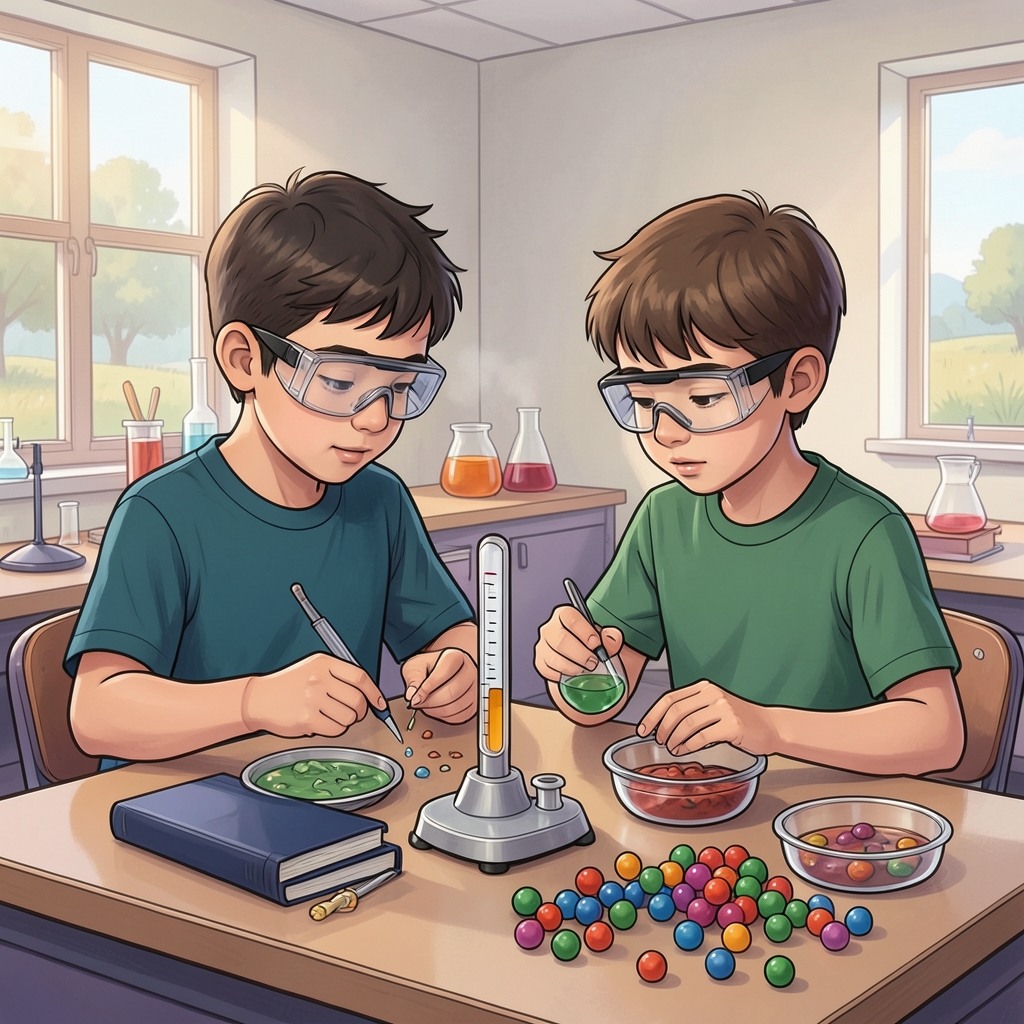
A quick look inside this lesson
What happens in class?
Question to start with
Which properties changed?
What students actually do
Organize the data and identify a pattern of changed or unchanged characteristic properties.
Evidence of learning
Two-scale reasoning with appropriate uncertainty.
Lesson plan
Chemical Reactions: Evidence & Conservation
A step-by-step guide to help you teach this lesson.
Extra context for teachers
Science notes: Chemical Reactions: Evidence & Conservation
A short concept refresher and teaching perspective. The full procedure, printable materials, and student tasks are available in the lesson resources above.
Science in context
Macroscopic evidence and microscopic models work together
Property data help us decide whether a reaction occurred at the observable scale.
What makes the idea observable?
A particle model shows two types of atoms grouped one way before a reaction and regrouped into new particles after it. Count each atom type on both sides. What stays the same?
Count atom types in physical/drawn models. Do not require atomic masses, symbolic equation balancing, valence-electron reasoning, or intermolecular-force explanations.
A misconception worth addressing
- Bubbles, color change, or temperature change alone are not the property-analysis focus of MS-PS1-2's assessment boundary.
- Conservation means each atom type is counted consistently before and after; atoms do not disappear.
Teacher tip
- Highlight before and after table columns.
- Use colored/symbol-labeled atom tiles so color is not the only identifier.
Plan with confidence
Lesson overview
What students will learn
- Analyze before-and-after characteristic-property data to determine whether the evidence supports that a chemical reaction occurred.
- Build and use a particle model showing atoms regrouping into products while the total number of each atom type remains unchanged.
Key science ideas
- Pure substances have characteristic properties that can help identify them.
- A pattern of changed properties before and after substances interact can support the conclusion that new substances formed.
- One observation alone may be ambiguous, so analyze the full dataset.
Lesson at a glance
- Grade 6
- 55 min
- ~10 min prep
- MS-PS1-2 · MS-PS1-5
- 4 materials
What’s included
- Lesson Plan
- Investigation
- Teacher Slides
- Printable Worksheet
- Teacher Answer Key
- Interactive Activity
- Vocabulary