Life Science · Matter and Energy in Ecosystems
Food Webs: Matter & Energy in Ecosystems
Build and read food webs to trace how matter and food energy move through an ecosystem. Use arrows carefully and make predictions from direct feeding relationships.
Read the science notes ↓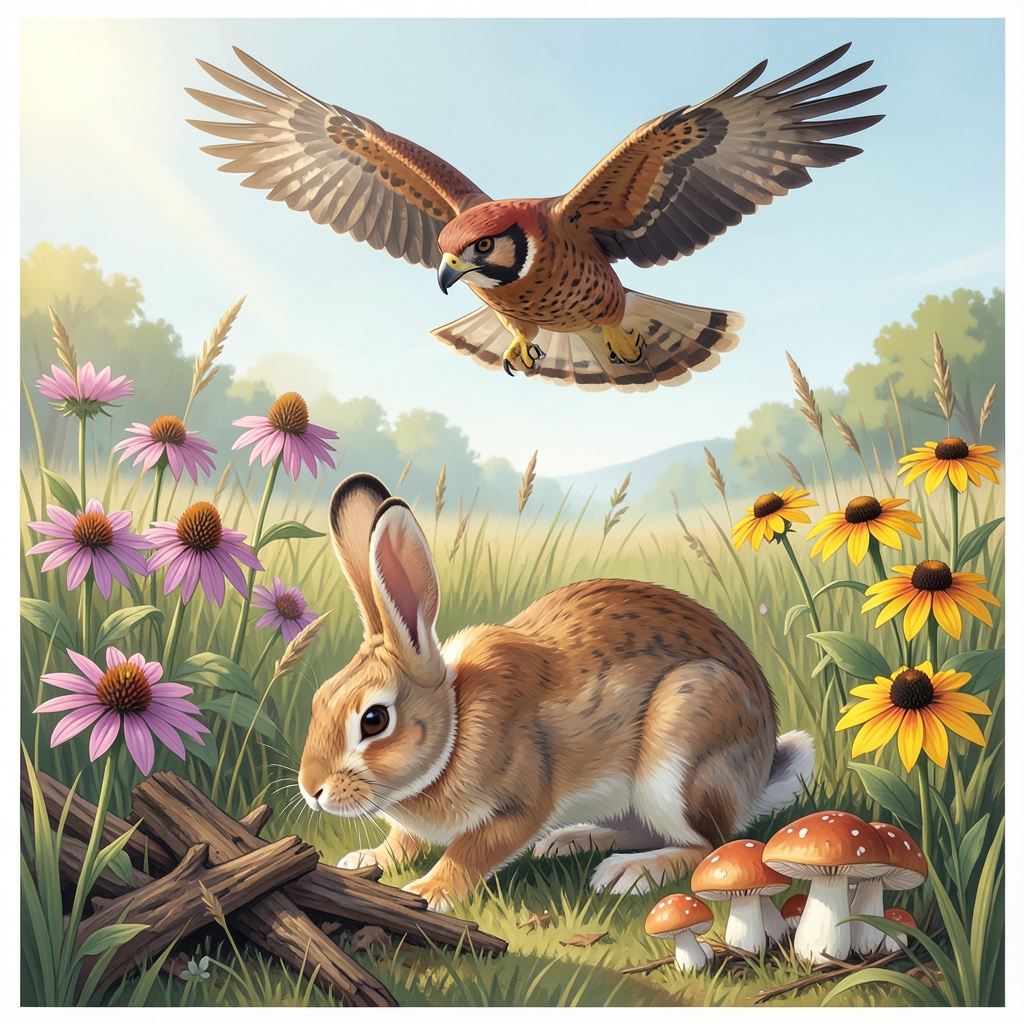
A quick look inside this lesson
What happens in class?
Question to start with
Where did the rabbit get its food?
What students actually do
Build, test, and revise a food-web model with producers, consumers, and decomposers.
Evidence of learning
Correct arrow direction, matter/energy distinction, and model-based evidence.
Lesson plan
Food Webs: Matter & Energy in Ecosystems
A step-by-step guide to help you teach this lesson.
Extra context for teachers
Science notes: Food Webs: Matter & Energy in Ecosystems
A short concept refresher and teaching perspective. The full procedure, printable materials, and student tasks are available in the lesson resources above.
Science in context
A food-web arrow is a claim about a feeding relationship, not just a line joining two animal pictures. If the agreed convention is food to eater, the arrow from grass to rabbit shows a route by which food matter and energy can pass into the rabbit. A missing arrow does not necessarily prove that two organisms never interact; it may simply reflect the limits of this particular model.
Matter and energy do not follow identical journeys. Matter can be reused as organisms grow, eat, release waste and decompose, while energy enters many food webs through sunlight and is ultimately dispersed as heat. Decomposers return matter to the environment; it would be misleading to draw an energy arrow cycling from decomposers straight back into sunlight. Any prediction about removing one organism should name the relationships shown and acknowledge that real populations have other influences.
Science reference: NASA eClips — Food webs, energy flow and matter cycling
What makes the idea observable?
In the model, an arrow points from grass to rabbit and another arrow points from rabbit to hawk. What does each arrow mean?
Use the stated arrow rule: food → eater. Follow several arrows to trace a pathway. Do not reverse the arrows just because a predator is larger.
A misconception worth addressing
- Food-web arrows must follow the stated convention consistently; this lesson uses food/source → eater.
- Matter can cycle through ecosystems, but energy does not cycle back to the Sun.
A practical teaching move
Show a short grass–rabbit–hawk pathway alongside a fuller web. Have students explain one arrow in words, trace a change through two connections, and say what the simplified model cannot tell them.
Plan with confidence
Lesson overview
What students will learn
- I can use a food-web model to trace feeding relationships among producers, consumers, and decomposers.
- I can explain that energy in animals' food can be traced back to the Sun through producers.
Key science ideas
- Producers form the base of many food webs.
- Consumers get food by eating other organisms.
- Decomposers break down dead material and return matter to the environment.
Lesson at a glance
- Grade 5
- 55 min
- ~10 min prep
- 5-LS2-1 · 5-PS3-1
- 7 materials
What’s included
- Lesson Plan
- Investigation
- Teacher Slides
- Printable Worksheet
- Teacher Answer Key
- Interactive Activity
- Vocabulary