Life Science · Body Structures & Movement
Finger & Muscle Model: How Do Pulling Structures Move Joints?
Build and test a finger model to explain how bones, joints, tendons, and muscles work together to produce bending and straightening.
Read the science notes ↓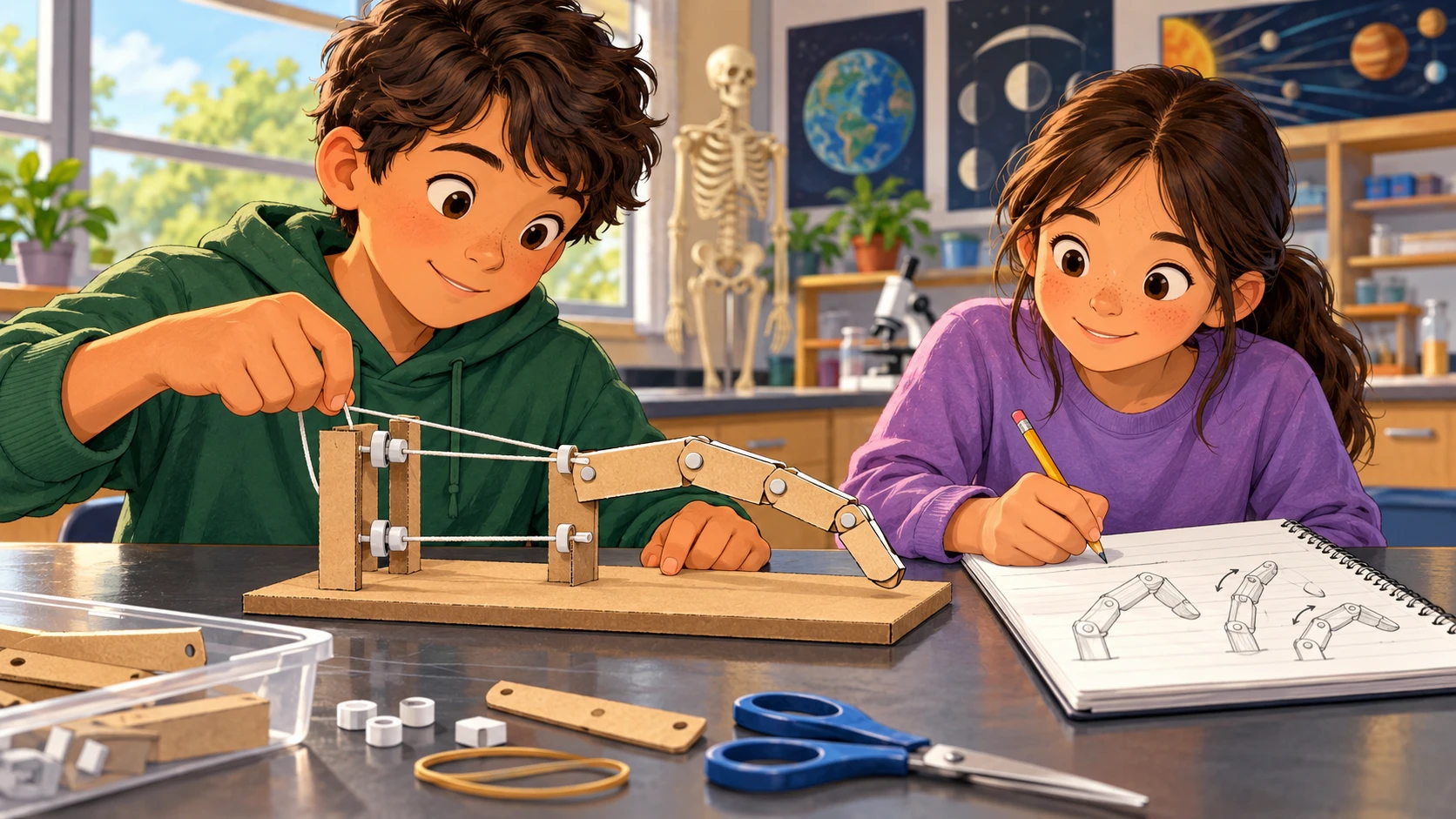
A quick look inside this lesson
What happens in class?
Question to start with
Which parts stay rigid?
What students actually do
Build, pull one string at a time, record the resulting motion, and troubleshoot string paths.
Evidence of learning
Useful-but-limited model evaluation.
Lesson plan
Finger & Muscle Model: How Do Pulling Structures Move Joints?
A step-by-step guide to help you teach this lesson.
Extra context for teachers
Science notes: Finger & Muscle Model: How Do Pulling Structures Move Joints?
A short concept refresher and teaching perspective. The full procedure, printable materials, and student tasks are available in the lesson resources above.
Science in context
Models explain relationships, not every detail
The model can show how a pulling force transmitted across joints changes finger position.
What makes the idea observable?
A model finger has jointed cardboard bones and two strings routed on opposite sides. What changes when only the palm-side string is pulled? What changes when the back-side string is pulled?
Treat the strings as tendon-like pulling structures. The student's hand provides the pull; the string itself is not a muscle.
A misconception worth addressing
- Tendons are not muscles; they connect muscle to bone.
- Muscles pull when they contract rather than pushing from a distance.
Teacher tip
- Provide pre-punched finger segments.
- Use a labeled model diagram before assembly.
Verified curriculum references
Plan with confidence
Lesson overview
What students will learn
- Use a physical model to connect bones, joints, tendons, and muscle pulling to finger movement.
- Collect evidence from model tests showing that pulling on different sides produces different joint motion.
Key science ideas
- Bones provide rigid structures that can move at joints.
- Muscles pull when they contract; they do not push bones from a distance.
- Tendons connect muscles to bones and transmit pulling force.
Lesson at a glance
- Grade 5
- 55 min
- ~15 min prep
- 7 materials
What’s included
- Lesson Plan
- Investigation
- Teacher Slides
- Printable Worksheet
- Teacher Answer Key
- Interactive Activity
- Vocabulary