Space Science · Earth, Moon & Sky
Moon Phase Modeling: Why Does the Moon Seem to Change Shape?
Use a light-and-ball model to explain why the Moon's visible illuminated part changes as the Moon orbits Earth, and test common phase misconceptions.
Read the science notes ↓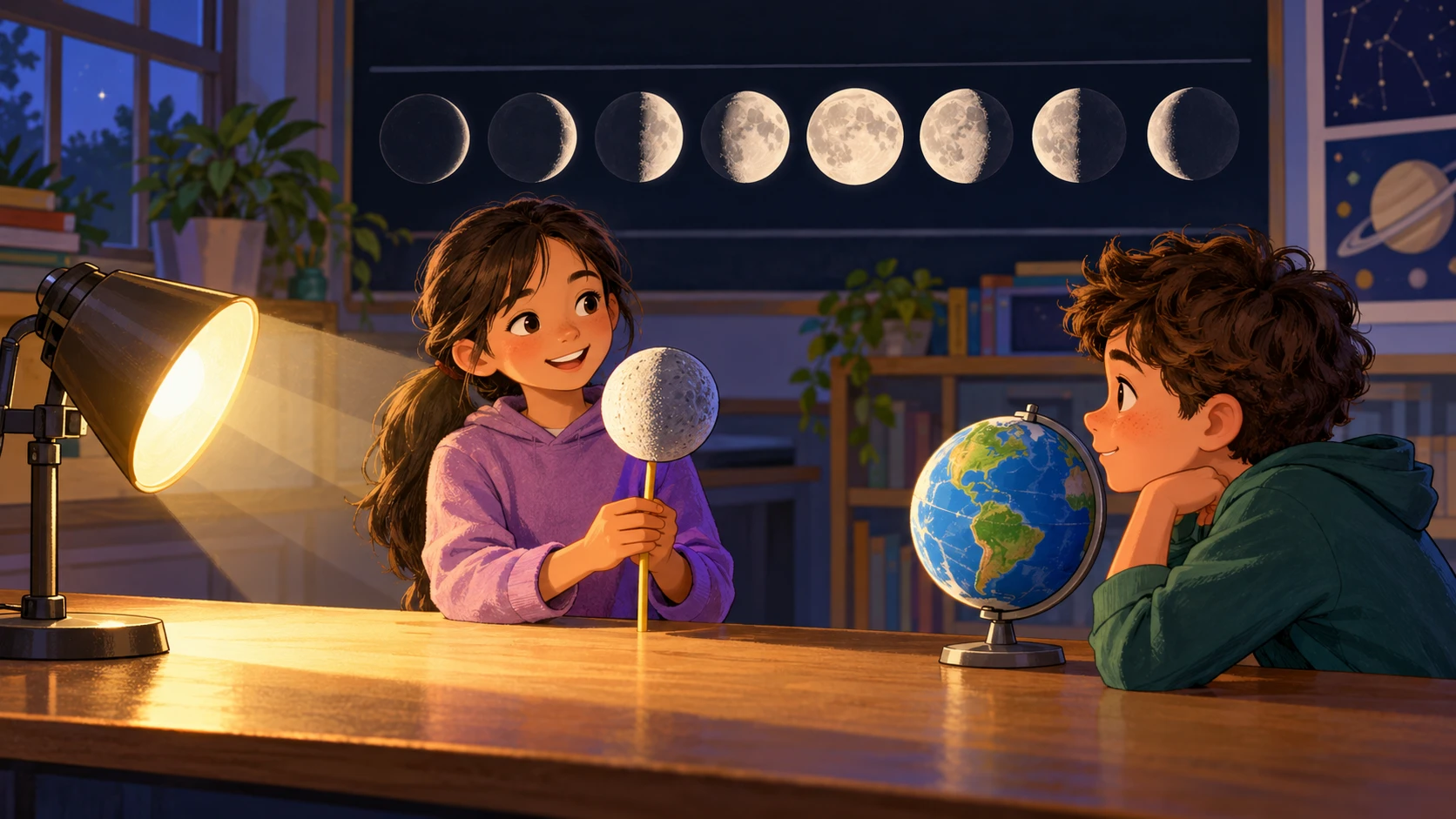
A quick look inside this lesson
What happens in class?
Question to start with
What stays the same about the Moon? What seems to change?
What students actually do
Keep their viewpoint at Earth, move the Moon ball, and sketch the visible lit portion at each position.
Evidence of learning
Consistent illumination geometry and viewpoint reasoning.
Lesson plan
Moon Phase Modeling: Why Does the Moon Seem to Change Shape?
A step-by-step guide to help you teach this lesson.
Extra context for teachers
Science notes: Moon Phase Modeling: Why Does the Moon Seem to Change Shape?
A short concept refresher and teaching perspective. The full procedure, printable materials, and student tasks are available in the lesson resources above.
Science in context
A model explains the pattern
At different Moon positions, an observer on Earth sees a crescent, half-lit quarter phase, gibbous phase, or nearly full illuminated disk.
What makes the idea observable?
A lamp represents the Sun, your head represents Earth, and a foam ball represents the Moon. As the ball moves around you, what changes: the half facing the lamp, or the amount of that lit half you can see?
The illuminated half remains the half facing the lamp. The visible portion changes with viewing geometry.
A misconception worth addressing
- The Moon does not make its own visible light.
- Ordinary phases are not Earth's shadow; Earth's shadow is involved in a lunar eclipse.
Teacher tip
- Use pre-drawn circles for students to shade.
- Let students rotate a model in pairs before writing.
Verified curriculum references
Plan with confidence
Lesson overview
What students will learn
- Use a physical model to explain that the Sun illuminates half of the Moon while our view of the lit half changes.
- Connect Moon positions in the model with visible phase patterns such as crescent, quarter, gibbous, and full.
Key science ideas
- The Sun illuminates half of the Moon at a time.
- As the Moon orbits Earth, our viewpoint lets us see different amounts of the illuminated half.
- That changing view creates the repeating pattern of Moon phases.
Lesson at a glance
- Grade 4
- 50 min
- ~10 min prep
- 5 materials
What’s included
- Lesson Plan
- Investigation
- Teacher Slides
- Printable Worksheet
- Teacher Answer Key
- Interactive Activity
- Vocabulary