Physical Science · Light and Seeing
Light Refraction: Why Does a Straw Look Bent in Water?
Explore why a straight straw appears bent in water, model how light refracts at air–water boundaries, and test the effect of viewing angle using evidence.
Read the science notes ↓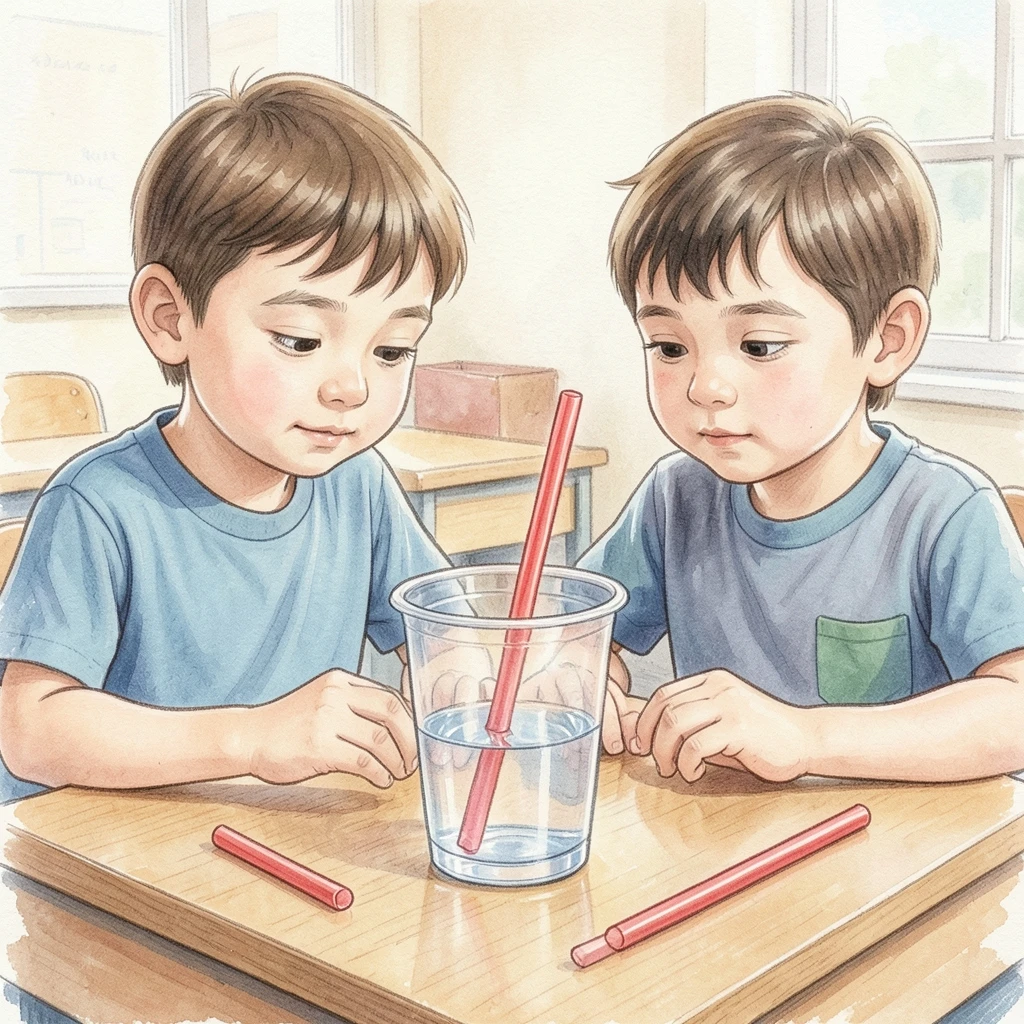
A quick look inside this lesson
What happens in class?
Question to start with
Which part looks changed? Which part is real?
What students actually do
Use explanatory feedback to refine their models.
Evidence of learning
Ray is a model, not a visible object.
One question from the printable worksheet
A classmate says the aquarium glass and water physically bend the toy. Explain why that claim is unsupported.
Lesson plan
Light Refraction: Why Does a Straw Look Bent in Water?
A step-by-step guide to help you teach this lesson.
Extra context for teachers
Science notes: Light Refraction: Why Does a Straw Look Bent in Water?
A short concept refresher and teaching perspective. The full procedure, printable materials, and student tasks are available in the lesson resources above.
Science in context
When a partly submerged straw looks bent, the straw itself has not changed shape. The apparent displacement comes from light changing direction as it travels between water and air. Where the ray crosses the boundary and the direction it takes toward the viewer are both important to the explanation.
The effect is not identical from every viewing position. A more informative model draws the waterline first and then traces light from the underwater part toward an observer. Distinguish this change in direction from reflection off the water surface; both can occur at the same boundary, but they explain different things the observer may see.
Science reference: NASA — Taking a Closer Look: Focusing Light
What makes the idea observable?
Look at the same straight straw first in an empty clear cup, then partly under water. What appears to change at the waterline, and what stays the same?
The straw does not physically bend. Observe from the side; the appearance may change with viewing angle, the shape of the container and where the waterline cuts the straw.
A misconception worth addressing
- The straw does not break or bend physically.
- Reflection and refraction may happen at the same interface.
A practical teaching move
Have students sketch what they see from two viewing angles before introducing a simple ray diagram. Ask what changed about the image and what remained unchanged about the object.
Verified curriculum references
Plan with confidence
Lesson overview
What students will learn
- Describe observations showing that a straight object can LOOK bent in water without changing shape.
- Use a simple ray model to explain that light changes direction when crossing between air and water at an angle.
Key science ideas
- Light travels through both air and clear water, but it moves at different speeds in them.
- At the slanted path across an air–water boundary, a light ray usually changes direction. This bending of light is refraction.
- Your eye traces incoming light backward in an apparently straight direction, so underwater parts can appear shifted.
Lesson at a glance
- Grade 4
- 50 min
- ~12 min prep
- 5 materials
What’s included
- Lesson Plan
- Investigation
- Teacher Slides
- Printable Worksheet
- Teacher Answer Key
- Interactive Activity
- Vocabulary