Life Science · Ecosystem Connections
Ecosystem Modeling: What Happens When One Population Changes?
Build and revise a simple ecosystem model, then use evidence to predict how a change in one population can affect connected organisms.
Read the science notes ↓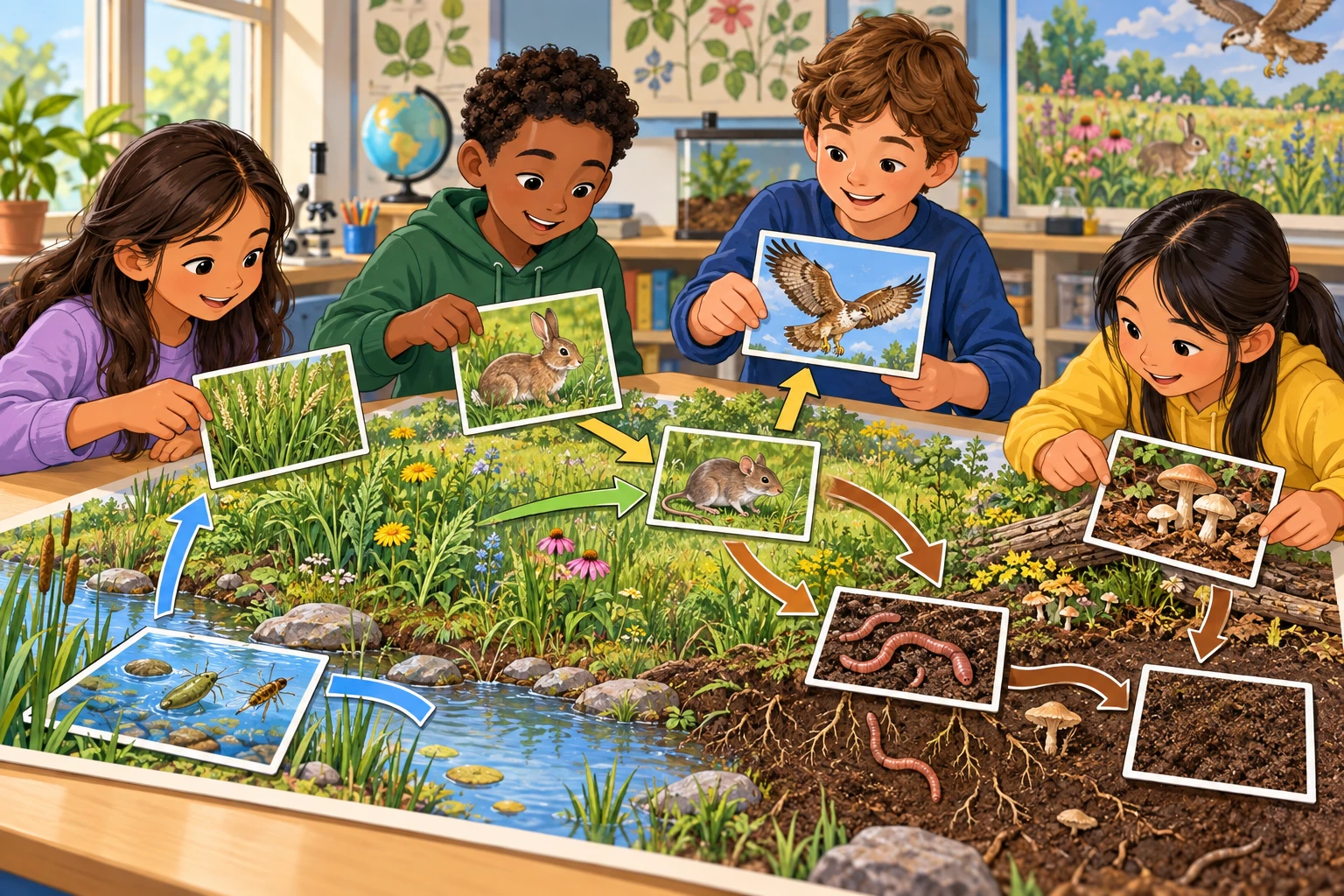
A quick look inside this lesson
What happens in class?
Question to start with
Which connection can you support from the evidence?
What students actually do
Build, explain, and test the model with a rabbit-decrease scenario.
Evidence of learning
Observable or countable evidence and careful language.
Lesson plan
Ecosystem Modeling: What Happens When One Population Changes?
A step-by-step guide to help you teach this lesson.
Extra context for teachers
Science notes: Ecosystem Modeling: What Happens When One Population Changes?
A short concept refresher and teaching perspective. The full procedure, printable materials, and student tasks are available in the lesson resources above.
Science in context
Models help us make careful predictions
A simple model can show possible effects, such as more food remaining for one population or less food available for another.
What makes the idea observable?
In a meadow, grasses are eaten by rabbits, rabbits are eaten by hawks, and decomposers break down dead material. If the rabbit population becomes much smaller, which connections should you inspect before making a prediction?
Students should trace direct and indirect connections rather than assuming every population changes in the same direction.
A misconception worth addressing
- A model prediction is not a guaranteed real-world outcome.
- Population changes can have more than one effect.
Teacher tip
- Use color-coded organism role cards.
- Provide sentence frames: If ___ decreases, ___ may ___ because ___.
Verified curriculum references
Plan with confidence
Lesson overview
What students will learn
- Build a model that shows feeding and resource connections among organisms in an ecosystem.
- Use a model and data to predict possible effects of a population increase or decrease.
Key science ideas
- Organisms in an ecosystem are connected by feeding relationships and shared resources.
- In this lesson, a feeding arrow points from the food or matter source to the consumer that receives it, such as grass → rabbit.
- A change in one population can affect organisms connected to it.
Lesson at a glance
- Grade 4
- 50 min
- ~10 min prep
- 5 materials
What’s included
- Lesson Plan
- Investigation
- Teacher Slides
- Printable Worksheet
- Teacher Answer Key
- Interactive Activity
- Vocabulary