Science Lesson Kit · Teacher Resource
Renewable Energy: Choosing Sources for a School — 5E Lesson Plan
Earth Science · 45 minutes
Grade 4
5E lesson flow
01
Engage
6 min
Teacher Does
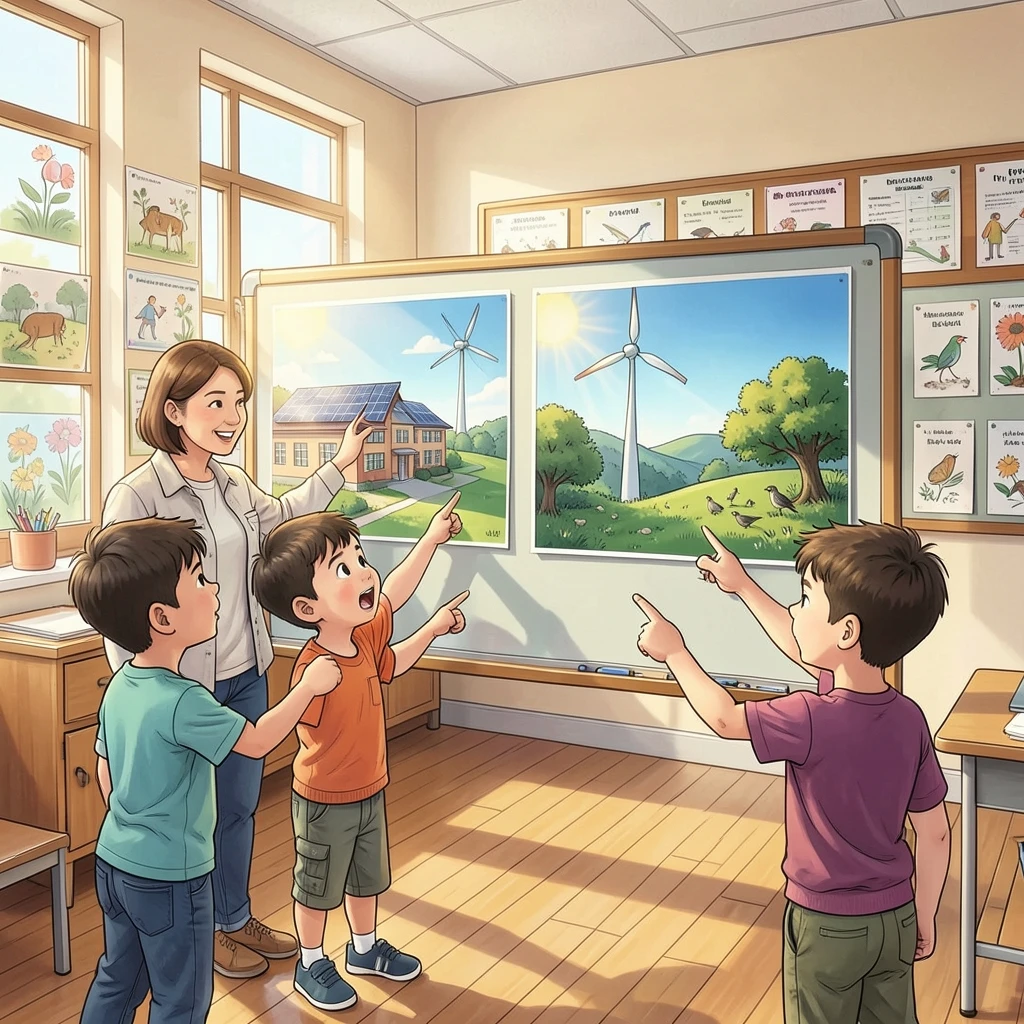
Show sunny roof and windy nesting-area scenes.
Students Do
Describe sunlight, wind and habitat trade-offs.
Ask
- Can a renewable source have an environmental effect?
Look For
Students answer yes with a reasonable example.
02
Explore
12 min
Teacher Does
Show resource cards, site maps and four-day fictional data.
Students Do
Compare the site options and highlight uncertainty.
Ask
- What did the records actually measure?
Look For
Students avoid forecasting year-round performance.
03
Explain
9 min
Teacher Does
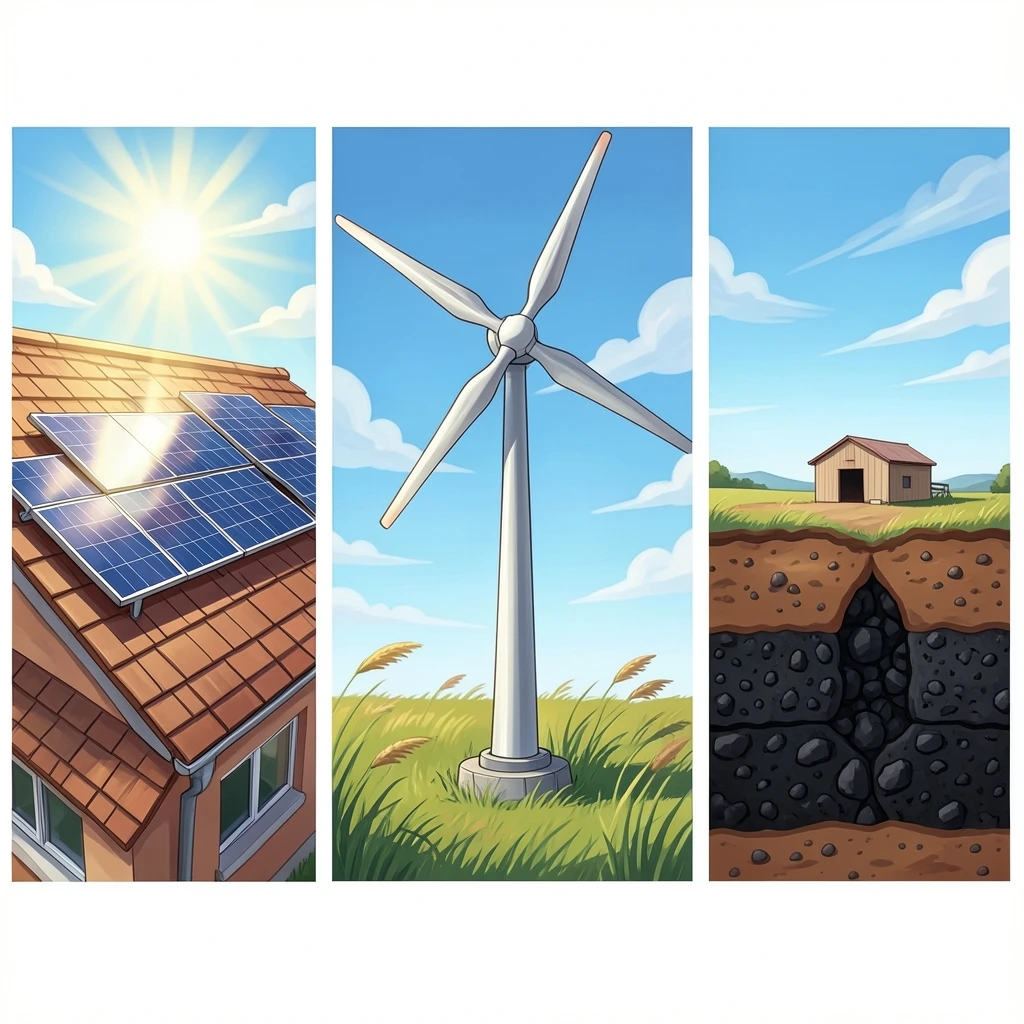
Compare renewable and fossil-fuel natural resources and trade-offs.
Students Do
Explain source, availability and environmental effect.
Ask
- Which resource is renewable on human timescales?
Look For
Students correctly contrast solar/wind and coal/oil.
04
Elaborate
12 min
Teacher Does
Introduce different library-site worksheet and support diagrams.
Students Do
Plan one source plus a backup or connection.
Ask
- What happens on cloudy or low-wind days?
Look For
Students explain conditions and environmental concern.
05
Evaluate
6 min
Teacher Does
Check worksheet and student argument.
Students Do
Defend a local recommendation with data and limitation.
Ask
- What more information should planners get?
Look For
A balanced recommendation with uncertainty.
Student goal
I can compare energy sources using local evidence, environmental effects, and a sensible limitation.
Learning objectives
- Identify sunlight, moving air and fossil fuels as sources of energy used by people, and distinguish renewable and nonrenewable resources.
- Compare two proposed school energy options using observation data and stated environmental trade-offs.
- Recommend a balanced energy plan for a fictional school using at least two pieces of evidence and one limitation.
Materials
- School energy picture cards
- Fictional four-day demonstration record
- Paper site map
- Pencils, colored markers
- Printed worksheet
Before class
- Use supplied fictional evidence as a teaching model, not actual site measurements.
- Do not wire electrical devices or install solar panels/turbines in class.
- For real siting decisions, environmental surveys and qualified professionals are needed.
- Prepare two columns for advantages and limitations.
Prior knowledge
- Electricity can power lights and devices.
- Weather conditions such as sunlight and wind change.
- Energy is not identical to its source.
Vocabulary
- renewable resource
- A resource replenished by natural processes over a useful time period, such as sunlight or wind.
- nonrenewable resource
- A resource used much faster than it forms, such as coal, oil, and natural gas.
- solar energy
- Energy from sunlight that panels can convert to electricity.
- wind energy
- Energy of moving air that wind turbines can convert to electricity.
- environmental impact
- A way an action or technology changes the surroundings.
- trade-off
- A benefit and a cost or limitation compared when choosing a solution.
Differentiation
- Provide two-column 'helps / needs checking' cards.
- Use oral justification sentence frame: 'I recommend __ because __, but __.'
- Advanced: rank reliability, habitat and available space without invented numerical energy output.
Assessment
- Correct original energy sources for solar and wind.
- Careful interpretation of four-day observation.
- Two features and one trade-off in new library case.
Exit ticket
Why isn't renewable energy automatically the perfect choice for every site?
Extension
Record cloudiness and wind observations for seven days WITHOUT connecting or touching electrical equipment.