Earth Science · Weather Hazards
Severe Weather: Design a Wind-Safe Shelter
Engineer a classroom shelter roof that resists strong model wind; test two designs fairly, compare data, and improve a solution.
Read the science notes ↓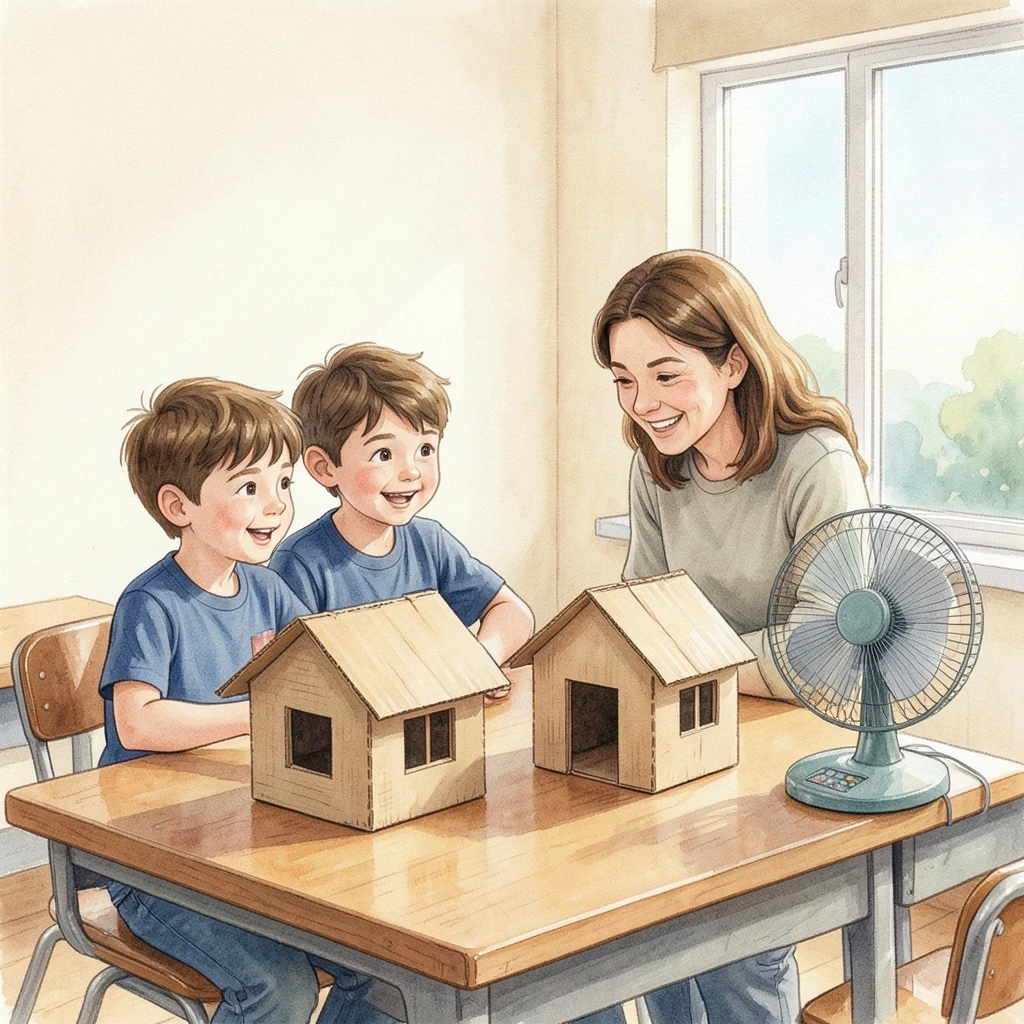
A quick look inside this lesson
What happens in class?
Question to start with
What might the wind push or lift?
What students actually do
Predict and record five passes per design.
Evidence of learning
Evidence-based answer with an explicit model limitation.
Lesson plan
Severe Weather: Design a Wind-Safe Shelter
A step-by-step guide to help you teach this lesson.
Extra context for teachers
Science notes: Severe Weather: Design a Wind-Safe Shelter
A short concept refresher and teaching perspective. The full procedure, printable materials, and student tasks are available in the lesson resources above.
Science in context
Use evidence, then improve
In the sample test, Design A stayed attached in 2 of 5 trials using 6 tabs. Design B stayed attached in 5 of 5 trials using 8 tabs. B meets both requirements.
What makes the idea observable?
Look at two small model shelters. Both have the same walls, but the roofs use different paper connections. What might happen when the same fan blows on them?
Invite predictions. Explain that this is a model of wind force, not a safe real-world shelter test.
A misconception worth addressing
- More materials is not automatically best if a limit is exceeded.
- Fair tests must use the same fan setting and distance.
Teacher tip
- Provide five empty boxes to mark each fan trial.
- Use icon cards for target and limit.
Verified curriculum references
Plan with confidence
Lesson overview
What students will learn
- Describe how strong winds can damage a roof and why engineers test shelter connections.
- Identify a measurable success criterion and a materials constraint, and plan a fair fan test.
Key science ideas
- Strong winds can lift weakly attached roof pieces.
- We can compare two model connections under the same fan speed, distance, roof size and number of trials.
- Our criterion: roof stays attached in at least 4 of 5 fan trials.
Lesson at a glance
- Grade 3
- 45 min
- ~12 min prep
- 3-ESS3-1
- 6 materials
What’s included
- Lesson Plan
- Investigation
- Teacher Slides
- Printable Worksheet
- Teacher Answer Key
- Interactive Activity
- Vocabulary